Hoffmann External Fixation System

Modular Stability for Acute Trauma & Complex Reconstruction
A next-generation unilateral/bilateral fixator featuring carbon fiber rodsquick-lock clamps, and multi-plane pin compatibility. Delivers rapid frame assembly (<3 mins) with CT/MRI transparency and 110kg weight-bearing capacity for staged fracture management.


Key Highlights:
✓ Ultra-Light Rigidity: Carbon fiber rods (4.8–11mm Ø) ↑ strength-to-weight ratio 3x vs. stainless steel
✓ Omni-Directional Clamps: 360° ball-joint motion + one-hand locking (30Nm torque)
✓ Hybrid Compatibility: Accepts 3–6mm Schanz pins (cortical/cancellous)
✓ Infection Control: Radiolucent design ↓ biofilm risk; open architecture for wound access
✓ Universal Indications: Acute fractures → nonunions → bone transport


Target Applications:
  • Open fractures (Gustilo III)
  • Pelvic ring disruptions
  • Infected nonunions
  • Limb lengthening (hybrid frames)


Reimagining external fixation – speed, strength, and imaging clarity unified.

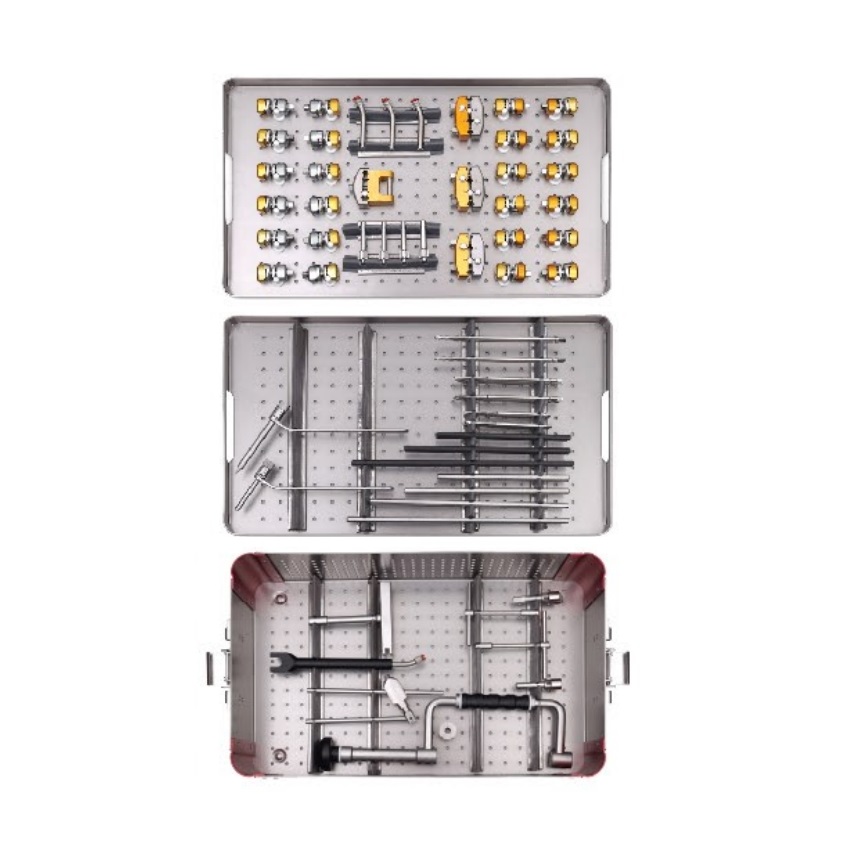
System Components

Upper Limb System

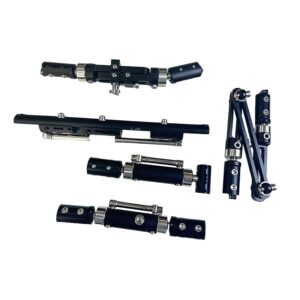
S/NP/NDescriptionSpecificationQTY
1B0022Combinational External Fixation System8.0mm1
2B0023Pin to Rod CouplingΦ8/4-53
3B0024Rod to Rod CouplingΦ8/84
4B00255-hole CouplingΦ8/51
5B002630º Angled PostΦ82
6B0027Semi-Circular Aluminum Connecting RodsΦ8*180mm1
7B0028RodΦ8*250mm2
8B0029Self-drilling & Self- tapping Pin5*150mm5
9B0030Screw DriverΦ5.01
10B0031T-Type Wrench#71
11B0021Spanner wrench#5/71

Lower Limb System

S/NP/NDescriptionSpecificationQTY
1B0011Combinational External Fixation System5.0mm1
2B0012Pin to Rod CouplingΦ5/3-42
3B0013Self-drilling & Self- tapping PinΦ4*120mm4
4B0014Rod to Rod CouplingΦ5/54
5B0015RodΦ5*2502
6B0016RodΦ5*2001
7B001730º Angled PostΦ52
8B00184-hole CouplingΦ51
9B0019Screw DriverΦ4.01
10B0020T-Type Wrench#51
11B0021Spanner wrench#5/71

Hoffmann External Fixation System Pioneering Legacy: Raoul Hoffmann (1881-1972)

Dr. Raoul Hoffmann, a Swiss surgeon practicing in Geneva, revolutionized orthopedic surgery with his invention of a modular external fixation system introduced in the late 1930s. Driven by the need for better solutions in treating complex war injuries, Hoffmann’s ingenious design centered on:
  • Truly Modular Concept: Independent placement of pins/wires connected via universal clamps to carbon fiber rods or rings, enabling unprecedented freedom in 3D assembly.
  • Universality: A single system adaptable to virtually any bone segment (long bones, pelvis, hand/foot) and indication (trauma, reconstruction, infection).
  • Stability & Adjustability: Enabling rigid fixation and post-operative reduction/correction via compression/distraction mechanisms.
  • Minimally Invasive Philosophy: Focused on preserving fracture biology and soft tissues.


Hoffmann’s principles laid the foundation for modern external fixation. Today’s evolution of his system (like Stryker’s Hoffmann family – II, III, Xtend, Hybrid) incorporates advanced materials (e.g., radiolucent carbon fiber) and refined clamping while honoring his core concept of adaptable stability. The name “Hoffmann” remains synonymous with external fixation worldwide.


Indications

The Hoffmann External Fixation System is indicated for the temporary or definitive stabilization of bone segments across diverse scenarios:
  1. Acute Trauma:
    • Severe open fractures (Gustilo II & III) to minimize contamination & stabilize.
    • Closed fractures with severe soft tissue compromise (swelling, burns).
    • Polytrauma patients (“Damage Control Orthopedics” – DCO).
    • Periarticular fractures requiring early joint motion.
    • Complex pelvic ring disruptions.
  2. Infected & Non-united Fractures: Stabilization during treatment of infection or malunion/nonunion.
  3. Limb Lengthening & Reconstruction: Distraction osteogenesis via specialized frames (often combined with ring elements).
  4. Arthrodesis (Joint Fusion): Temporary stabilization for joints (e.g., ankle, wrist).
  5. Severe Bone Loss: Bridging significant defects.
  6. Correction of Deformities: Gradual correction of angular/rotational deformities.
  7. Pediatric Fractures: Cases unsuitable for internal fixation.
  8. Reinforcement: Supplementing unstable internal fixation (“protection” frame).

Contraindications

Contraindications are relative and require careful risk-benefit assessment by the surgeon:
  1. Unstable Patient: Severely unstable medical status prohibiting any surgery.
  2. Pin/Wire Site Infection: Active infection at potential insertion sites (relative contraindication; requires careful planning/alternative sites).
  3. Severe Osteopenia/Osteoporosis: Inadequate bone stock to securely hold pins/wires.
  4. Severe Skin/Soft Tissue Insufficiency: Where pin placement could cause necrosis or persistent infection.
  5. Allergy to Implant Materials: Very rare, but must be considered.
  6. Patient Non-compliance/Irreducible Non-adherence: Inability or unwillingness to manage pins sites, attend follow-up, or follow weight-bearing restrictions.
  7. Lack of Surgical Expertise: Requires specific training and experience.


The final decision to use the Hoffmann System rests solely on the surgeon’s clinical judgment after thorough evaluation.

Surgical Technique (Overview & Key Principles)

The Hoffmann System enables numerous techniques. This overview covers universal principles:
  1. Preoperative Planning:
    • Imaging Review (X-rays, CT scans).
    • Define frame configuration (unilateral, biplanar, hybrid, ring), pin/wire placement sites (avoiding neurovascular structures & future incision sites for possible conversion).
    • Template assembly (optional).
    • Select component sizes (pin diameter, rod length).
  2. Patient Positioning & Prep: Position to allow access and imaging. Sterile prep/drape widely.
  3. Pin/Wire Insertion (“Safe Corridors”):
    • Use sharp drills/sleeves under power or hand drilling to minimize thermal necrosis.
    • Predrill near cortex before inserting self-drilling/self-tapping pins if applicable.
    • Use tissue protection sleeves. Insert perpendicular to bone axis (when possible) or follow planned trajectory.
    • Ensure bicortical purchase when possible. Avoid thermal injury (continuous saline irrigation optional).
    • Minimize soft tissue tension around pins.
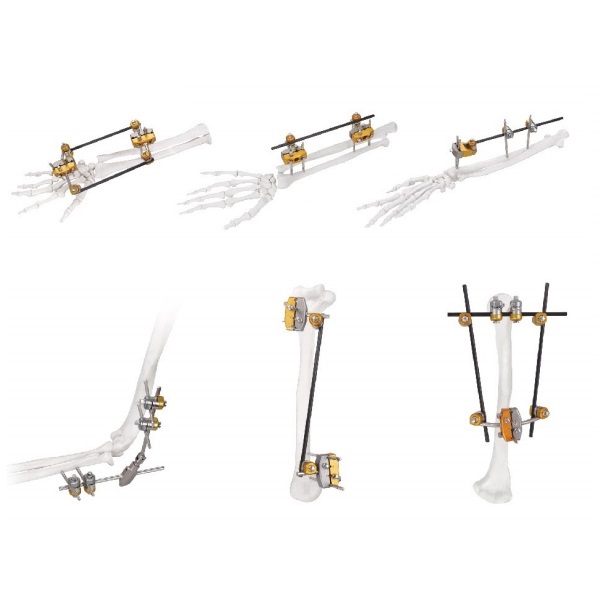
  4. Frame Assembly & Reduction:
    • Apply single pins/wires with hand tight clamps.
    • Attach rods/stars/rings.
    • Use clamp articulation strategically to aid reduction.
    • Perform fracture reduction (manually or via frame manipulation – traction/compression/angulation).
    • Securely lock all clamp bolts (torque-limiting wrench required). Add secondary rods/rings for stability as needed (triangle principle).
  5. Final Check:
    • Verify stability and reduction clinically & radiographically (e.g., fluoroscopy).
    • Ensure clearance from skin (approx. 1-3 cm).
    • Trim pins/wires if excessively long.
    • Cover pin sites with non-occlusive, saline-moistened dressing.
    • Apply protective caps to sharp ends.
  6. Post-operative Management:
    • Strict Pin Site Care Protocol initiation & patient education.
    • Pain management & neurovascular monitoring.
    • Follow-up schedule for assessment, potential adjustment (e.g., distraction), or planned conversion to internal fixation.
    • Clear weight-bearing instructions.
“Note:* Comprehensive techniques require specific training using the manufacturer’s surgical technique guide (IFU – Instructions for Use). Techniques vary significantly based on indication, anatomy, and surgeon preference.*

Features & Advantages (Modern Hoffmann Family):

  • Universal Clamps: Secure multiple pin diameters (e.g., 4.0mm, 5.0mm, 6.0mm), wires, and rods/stars with single clamp types.
  • Multi-Directional Clamps: Highly adjustable angle/stiffness clamps (e.g., Hoffmann III/Xtend) enable complex frame assembly and correction.
  • Quick-Lock Clamps: Rapid deployment clamp options (e.g., Hoffmann III Quick-Lock).
  • Radiolucent Carbon Fiber Rods: Improve radiographic visibility during surgery and follow-up.
  • Lightweight & Durable: Advanced metals and composites.
  • Extensive Compatibility: Interfaces with other fixation components (e.g., rings for hybrid frames).
  • Comprehensive Instrumentation: Dedicated guides, wrenches, driver handles, pin cutters.

Key Considerations

  • Pin Site Care: Critical for preventing infection. Patient education is paramount.
  • Stiffness vs. Dynamization: Frame stiffness must match clinical need. Dynamization may be beneficial later.
  • Conversion Planning: Frame placement should facilitate safe future conversion to internal fixation if planned.
  • Neurovascular Anatomy: Mastery of cross-sectional anatomy is mandatory for safe pin insertion.
Disclaimer: The information provided here is intended as a general overview for medical professionals. It is not a substitute for the manufacturer’s official Instructions for Use (IFU), specific surgical training, or a surgeon’s clinical judgment. Product specifications, indications, contraindications, warnings, precautions, and surgical techniques may vary. Always refer to the specific product labeling and validated surgical technique guides for the Hoffmann system being used prior to any procedure.
About Us
Welcome to Lyntop Medical, we are a premium orthopedic implants & instruments supplier from China.
Our mission is to make high-quality orthopedic medical devices accessible and affordable across the globe.
Together, we empower your surgeons to Alleviate Pain and Restore Mobility for patients.

Contact Us Immediately

Our dedicated team is at your service 24/7.