
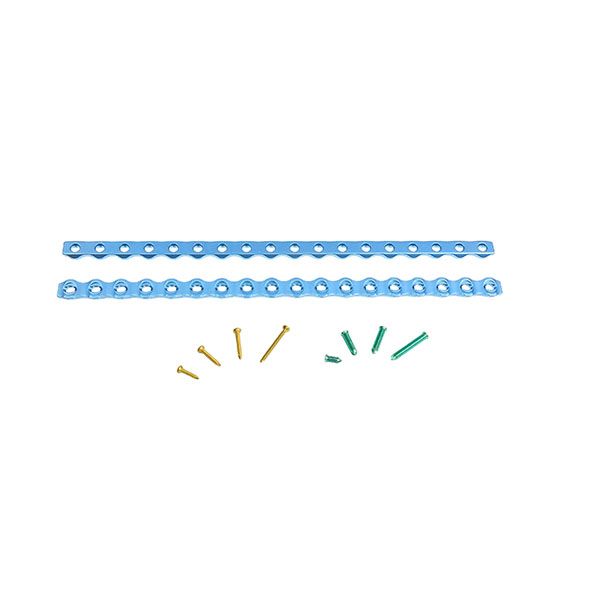
Our Advanced Locking Plate System represents the next generation of biological internal fixation for small animal orthopedics. Engineered with a focus on Biological Osteosynthesis (BO), this system minimizes surgical trauma and maximizes the preservation of the bone’s natural healing environment.
Traditional bone plates rely on heavy compression against the bone, which can crush the periosteum and restrict blood flow. Our Type I system utilizes a minimal point-contact design on the plate’s underside. By touching the bone only at strategic points, it leaves the periosteal blood supply largely intact, leading to faster callus formation and reduced risk of bone necrosis.
Fixed-Angle Locking Technology: The threaded screw-to-plate locking mechanism creates a stable, rigid construct that does not rely on plate-to-bone friction. This ensures superior stability even in osteopenic bone.
Reduced Contact Geometry: The scalloped underside reduces the contact area between the implant and the bone, significantly lowering the impact on vascularity compared to standard dynamic compression plates (DCP).
Medical Grade Titanium: Manufactured from high-strength, biocompatible titanium. Titanium offers a lower modulus of elasticity than stainless steel, reducing “stress shielding” and promoting healthier bone remodeling.
K-Wire Alignment Holes: Features dedicated positioning holes for temporary K-wire fixation, allowing for precise intraoperative plate alignment before final screw insertion.
| Feature | Details |
| Material | High-Grade Biocompatible Titanium |
| Fixation Mode | Locking (Fixed-Angle) System |
| Design Type | Minimal Contact / Biological Fixation |
| Available Sizes | Optimized for 1.5mm, 2.0mm, and 2.4mm Screw Systems |
| Clinical Focus | Feline, Toy-breed, and Small-breed fractures |
Accelerated Healing: By preserving the periosteal vasculature, the biological healing process begins sooner post-op.
Reduced Infection Risk: Minimal contact reduces the “dead space” under the plate where bacteria can colonize, enhancing the patient’s long-term safety.
Anatomical Versatility: The low-profile design is ideal for areas with minimal soft tissue coverage, such as the distal radius and ulna.
Precision Engineering:
We delivers orthopedic implants and instruments engineered for accuracy and optimal performance.
Quality Materials:
We utilize premium biocompatible materials in all orthopedic solutions, ensuring durability and patient safety.
Comprehensive Portfolio:
We offers a diverse range of implants and instruments to address various orthopedic needs.
Surgeon-Focused Design:
Our instruments are designed in collaboration with surgeons to enhance procedural efficiency and ease of use.
WhatsApp us


